
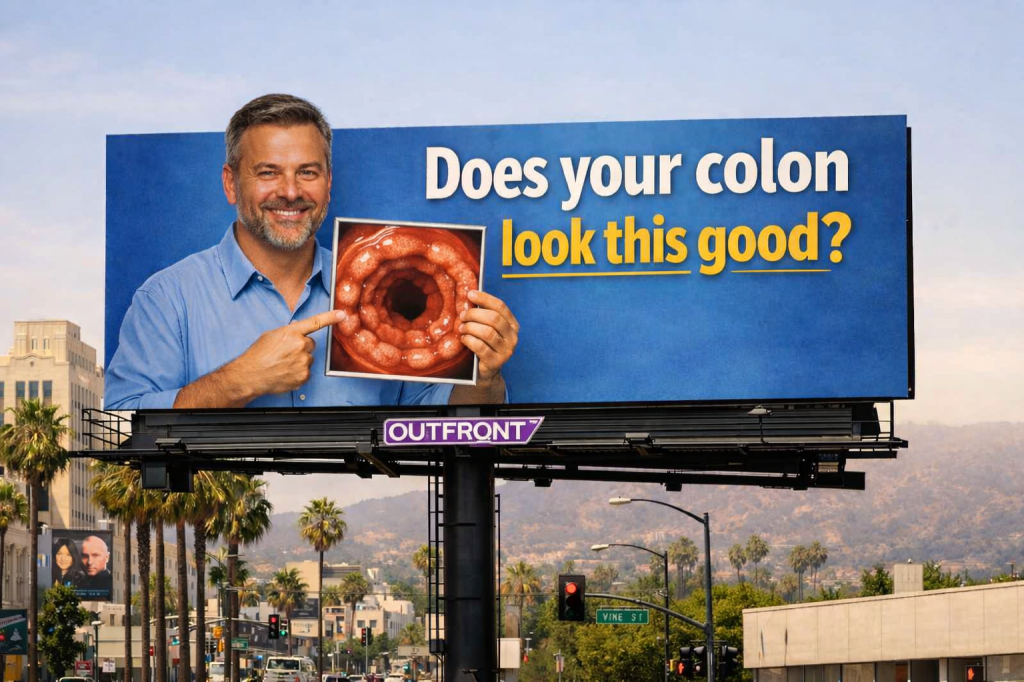
Los Angeles, CA – A lawsuit that began as a routine medical privacy dispute has evolved into one of the most unusual legal battles currently making its way through California courts, after a Los Angeles man alleged that a hospital improperly used images from his colonoscopy in educational materials and a public advertising campaign without his consent.
The plaintiff, 52-year-old Dennis Harper, filed an amended complaint Monday alleging that Pacific Coast Medical Center used photographs of his colon in brochures, conference materials, and a public billboard advertisement without authorization or compensation.
Harper is seeking $4.2 million in damages for emotional distress, reputational harm, invasion of privacy, lost income, and what court documents describe as “the unauthorized commercial exploitation of a uniquely identifiable gastrointestinal likeness.”
The lawsuit centers on a billboard that reportedly appeared along Interstate 405 near Los Angeles International Airport. According to court filings, the advertisement featured a large colonoscopy image accompanied by the slogan:
“DOES YOUR COLON LOOK THIS GOOD?”
Harper claims he nearly drove off the road after spotting the billboard during his morning commute.
“I looked up and immediately knew it was mine,” Harper told reporters outside the courthouse. “The fold structure, the coloration, the heart-shaped mark. That’s not just any colon. That’s my colon.”
According to the complaint, Harper has spent nearly twenty years working as what he describes as a professional colon model, licensing images of his digestive tract for medical publications, conferences, educational presentations, and industry publications.
“I’ve spent years maintaining this colon,” Harper said. “High fiber diet. Limited processed foods. Regular screenings. You don’t just wake up with a colon that looks this good.”
His attorneys argue that the issue extends far beyond simple embarrassment.
“Medical images are intellectual property when properly licensed, and they are protected health information when connected to a patient,” said attorney Robert Feldman. “Hospitals cannot simply take diagnostic images and use them for promotional purposes without obtaining appropriate authorization.”
The amended complaint cites both federal and California privacy protections, arguing that patient medical imagery is subject to strict safeguards intended to prevent unauthorized disclosure.
While hospitals frequently use anonymized medical images for educational purposes, Harper’s attorneys contend that the distinctive characteristics of his colon make true anonymization impossible.
“The defense may claim this is simply a picture of a colon,” Feldman said. “Our position is that this particular colon possesses unique and recognizable characteristics that function much like a fingerprint.”
Court documents describe several allegedly distinctive features, including an unusually symmetrical fold pattern and a naturally occurring heart-shaped pigmentation mark that Harper’s legal team argues makes identification straightforward.
The filing further alleges that the hospital violated established industry practices governing licensed medical photography.
“Organizations routinely pay licensing fees for medical imagery,” the complaint states. “The unauthorized use of a professional colon model’s image undermines established commercial markets and deprives the owner of rightful compensation.”
The lawsuit alleges that Harper typically earns between $5,000 and $15,000 for authorized use of his images in professional educational settings. Attorneys estimate the value of the billboard campaign alone could exceed six figures had proper licensing agreements been negotiated.
Harper claims he first discovered the alleged unauthorized use while visiting the hospital for an unrelated appointment. After spotting a patient brochure in the waiting room, he reportedly suffered what the lawsuit describes as acute emotional shock.
“I turned the page and there it was,” Harper said. “No credit. No compensation. Not even a photo caption. Imagine opening a magazine and finding your face in an advertisement you never approved. Now imagine that face is your colon.”
The complaint further alleges that Harper became the subject of jokes among coworkers after the billboard campaign launched. Friends and family reportedly began sending him photographs of the advertisement after recognizing what they described as his “signature colon.”
One acquaintance allegedly texted him a photo of the billboard with the message, “Congratulations on making it big.”
Another reportedly asked whether he would be signing autographs at an upcoming gastroenterology conference.
The lawsuit further claims the widespread publication damaged Harper’s standing within the competitive colon-modeling industry and cost him a potential endorsement agreement with a probiotic manufacturer.
“Exclusivity is everything,” Feldman said. “Once a colon image is widely distributed, it loses value. Nobody wants yesterday’s colon.”
Pacific Coast Medical Center declined to comment on specific allegations but issued a brief statement saying it takes patient privacy seriously and intends to defend itself vigorously.
Legal observers say the case could hinge on whether the court accepts the argument that a colonoscopy image can be sufficiently distinctive to identify a specific individual.
Healthcare attorney Melissa Grant, who is not involved in the case, said the lawsuit presents an unusual legal question.
“Most privacy disputes involve faces, names, or traditional identifying information,” Grant said. “This case asks whether a person can be recognized through internal anatomical features alone. It’s certainly not a question courts encounter every day.”
As reporters wrapped up questioning outside the courthouse, Harper made clear that his fight is about more than money.
“People hear the word ‘colon’ and they laugh,” Harper said. “But in Los Angeles, image is everything. Some people make a living with their face. Some people make a living with their abs. I make a living with my colon.”
Harper said he was particularly offended by the billboard campaign.
“I spent years building this brand,” he said. “Then one day I’m driving down the 405 and there it is, thirty feet tall, asking strangers if their colon looks this good. No permission. No compensation. Not even a credit.”
According to the complaint, Harper believes the billboard transformed what had previously been a niche professional asset into a public spectacle.
“If you’re going to put my colon in front of millions of commuters, the least you can do is pay standard modeling rates,” he said. “That’s how this business works.”
His attorney echoed that sentiment.
“This case isn’t really about anatomy,” Feldman said. “It’s about ownership, consent, and compensation. Whether you’re talking about a face, a voice, or a colon, nobody should be able to profit from your image without permission.”
Harper said he hopes the lawsuit sends a message to healthcare organizations across the country.
“Today it’s me,” he said. “Tomorrow it could be somebody else’s colon.”
A preliminary hearing is scheduled for next month in Los Angeles Superior Court.

