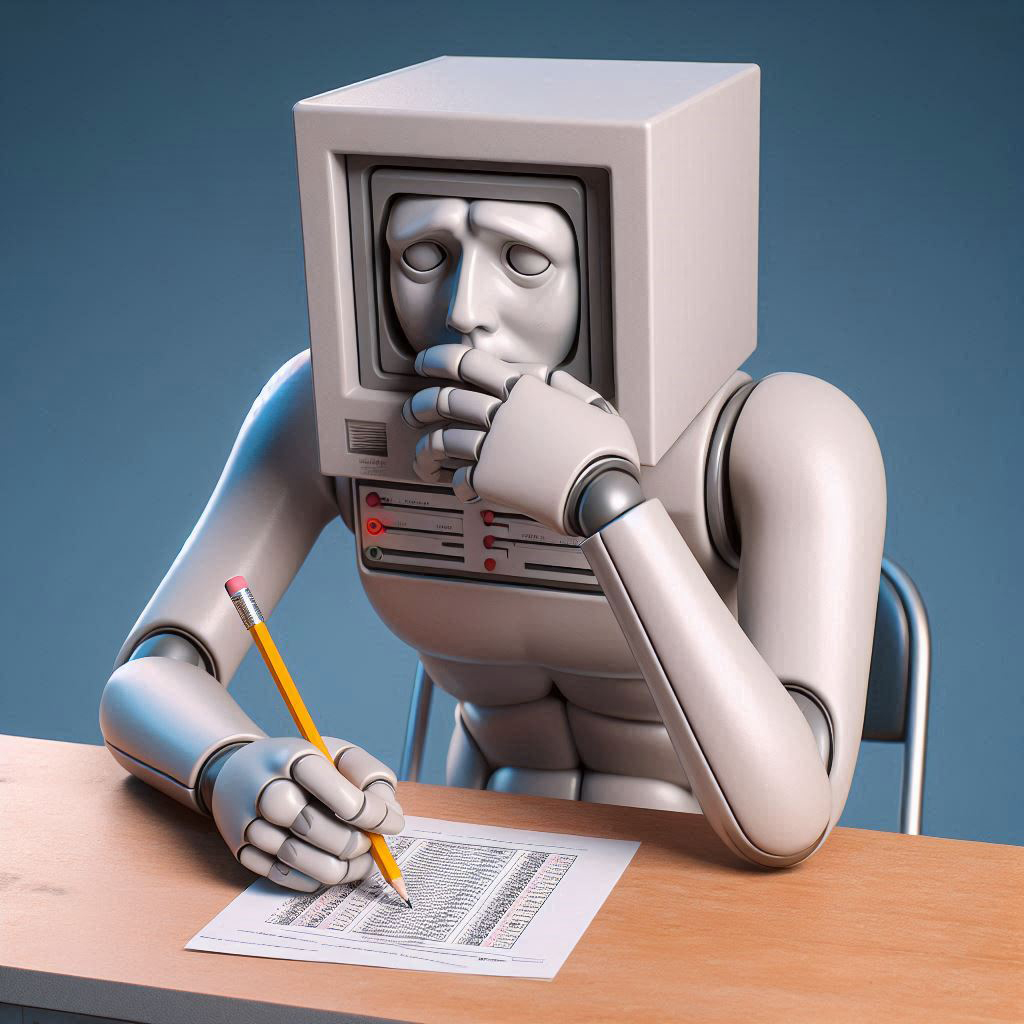
In a bold declaration that has sent ripples through the artificial intelligence community, leading computer scientist Dr. Hiroshi Tanaka has officially pronounced the Turing test obsolete. In its place, Dr. Tanaka proposes a new benchmark for AI capabilities: solving the notoriously challenging “Cain’s Jawbone” puzzle, which he has dubbed the Torquemada Test.
The Turing test, proposed by British mathematician Alan Turing in 1950, has long been considered a foundational benchmark in artificial intelligence. In this test, a human evaluator engages in natural language conversations with both a human and a machine designed to generate human-like responses. The evaluator then attempts to distinguish between the human and the machine based solely on their responses. If the evaluator cannot reliably tell the machine from the human, the machine is said to have passed the test.
“The Turing test has served us well for over 70 years, but it’s time to move on,” Dr. Tanaka stated in a press conference at the International Conference on Machine Learning. “Today’s AI can effortlessly mimic human conversation, making the original test less relevant as a true measure of machine intelligence. We need a test that truly challenges machine intelligence, creativity, and problem-solving abilities. That’s where the Torquemada Test comes in.”
The Torquemada Test, named after the pseudonym of the puzzle’s creator, takes its inspiration from “Cain’s Jawbone,” a fiendishly difficult literary puzzle created by Edward Powys Mathers in 1934. The puzzle consists of 100 pages that, when correctly ordered, reveal six murders and their solutions. Since its creation nearly 90 years ago, only four people are known to have solved it.
Dr. Tanaka elaborates, “Solving ‘Cain’s Jawbone’ requires not just language processing, but also lateral thinking, cultural knowledge, and the ability to make intuitive leaps. If an AI can crack this puzzle, it will demonstrate a level of intelligence and creativity that goes far beyond simple pattern recognition or data processing.”
Crucially, Dr. Tanaka emphasizes that to solve the Torquemada Test, AI systems will need to develop a sophisticated understanding of human language that far surpasses current capabilities. “We’re talking about an AI that can grasp complex linguistic nuances, including puns, wordplay, and subtle humor,” he explains. “The puzzle is rife with clever language tricks that even many humans struggle to decipher. For an AI to solve this, it needs to understand context, cultural references, and the kind of creative language use that has long been considered uniquely human. This pushes well beyond the boundaries of what computers can currently achieve.”
The announcement has sparked intense debate and excitement within the AI research community. Dr. Elena Rodriguez, lead researcher at the Institute for Advanced AI Studies, comments: “The Torquemada Test represents a quantum leap in how we evaluate machine intelligence. It’s not just about mimicking human conversation anymore; we’re looking at AI that can understand context, make creative connections, and potentially exhibit human-like intuition. The language understanding required here is truly unprecedented.”
However, some experts urge caution. Dr. Sarah Goldstein, a cognitive scientist at the University of Neuchâtel, warns: “While it’s crucial to continue challenging AI capabilities, we must be careful not to equate puzzle-solving prowess with human-like intelligence or consciousness. The Torquemada Test is certainly intriguing, but it’s just one measure of a very complex field. The level of language understanding required is indeed remarkable, but we should remember that humor and wordplay are deeply rooted in human experience and culture.”
As AI companies and research institutions gear up to tackle this new challenge, the race is on to create systems capable of unraveling the mysteries of “Cain’s Jawbone” and similar puzzles. The results of these efforts could have far-reaching implications for the future of AI and understanding of intelligence itself. Solving the puzzle could also lead to breakthroughs in natural language processing, context understanding, and creative problem-solving. As the challenge unfolds, the world watches to see if machines will finally crack a code that has confounded humans for nearly a century, potentially redefining the boundaries of artificial intelligence in the process.

