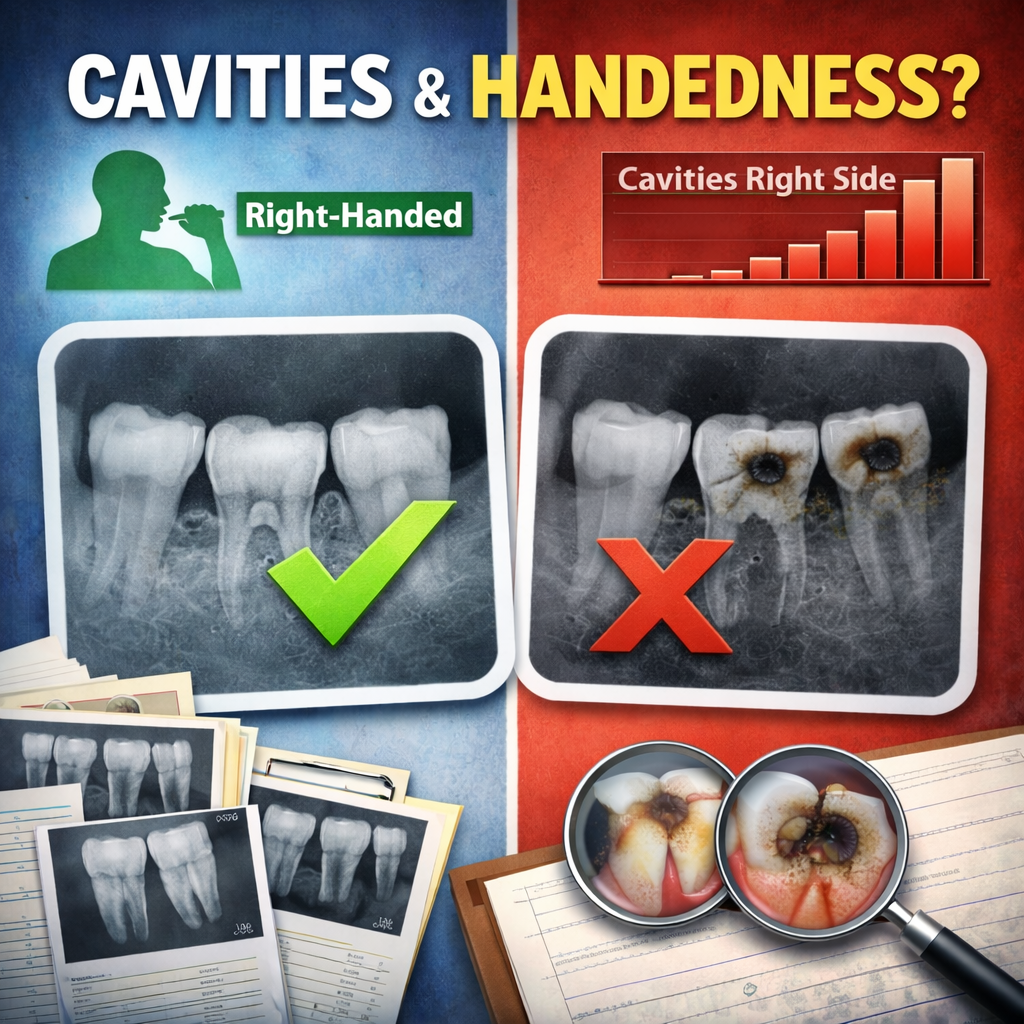
Ann Arbor, MI – A new dental research paper is stirring discussion among oral health specialists after concluding that the majority of cavities may occur on the right side of the mouth, a pattern researchers believe is tied to the fact that most people are right handed and struggle to brush that side effectively.
The study, published this month in the Journal of Preventive Oral Health, analyzed more than 120,000 dental records from clinics in the United States, Canada and Europe over a 15 year period. Researchers say the data revealed a consistent asymmetry in tooth decay patterns, with right sided molars and premolars showing significantly higher rates of cavities among right handed patients.
According to the paper’s lead author, epidemiologist Dr. Martina Alvarez of the University of Michigan School of Dentistry, the explanation may lie in the mechanics of brushing.
“When a right handed person holds a manual toothbrush, the wrist angle and elbow position make it easier to reach the left side of the mouth with proper pressure and brush orientation,” Alvarez said in an interview. “The right side requires a more awkward rotation of the wrist, which often results in shorter brushing strokes and poorer plaque removal.”
The research team reviewed dental charts and X rays from 121,452 adult patients and categorized cavities by tooth position, handedness, age and brushing habits. Roughly 89 percent of the sample population identified as right handed, consistent with global estimates that about 90 percent of people favor their right hand for most tasks.
Among right handed participants, the study found that 63 percent of all cavities occurred on the right side of the mouth. Right side molars showed 27 percent higher decay rates than their left side counterparts. Plaque scores measured during routine dental exams were 18 percent higher on average on the right side.
Researchers also conducted a five year longitudinal follow up on a subset of 3,200 patients who received regular cleanings and cavity monitoring. The same asymmetry persisted over time, suggesting that the imbalance was not simply a one time finding.
Previous dental studies have noted that plaque distribution can differ depending on which hand a person uses to brush. Some research has shown that right handed toothbrush users accumulate significantly more plaque and gingivitis on the right side of the mouth. Other studies have concluded that handedness can influence how effectively people remove plaque from different areas of the mouth because oral hygiene relies heavily on manual dexterity.
The new study also found a smaller but notable mirror image effect among left handed individuals.
Among the 11 percent of participants who reported being left handed, the researchers observed a modest shift in decay patterns toward the left side of the mouth. In that group, cavities were about 19 percent more likely to occur on the left side than on the right.
Dental biomechanics may explain the reversal. Earlier clinical studies have suggested that left handed patients often have better brushing access to the right quadrants of the mouth, while right handed patients show better plaque control on the left.
“This is essentially a motor control issue,” Alvarez said. “The dominant hand can maintain better angle stability on the opposite side of the mouth. On the same side, the brushing motion becomes less precise.”
Dentists caution that the findings should not alarm patients but rather highlight the importance of brushing technique.
Tooth decay develops primarily when bacterial plaque remains on teeth and produces acids that erode enamel. Proper brushing is the main mechanical method for removing plaque before it leads to cavities or gum disease.
Dr. Kevin Sato, a preventive dentistry specialist in Seattle who was not involved in the study, said the results reinforce a common observation in clinical practice.
“Dentists often notice that patients tend to miss the same spots repeatedly,” Sato said. “For many right handed people, the lower right molars and upper right back teeth are frequent trouble areas.”
Researchers say simple behavioral changes may reduce the imbalance. These include starting brushing on the side that feels harder to reach, using a mirror to monitor brushing angles, extending brushing time by 20 to 30 seconds, switching occasionally to the non dominant hand and using powered toothbrushes, which have been shown to remove more plaque in some cases.
The authors emphasize that cavities are influenced by many factors including diet, fluoride exposure and saliva production and that handedness alone does not determine oral health outcomes.
Researchers say more work will be needed to confirm the findings across different populations and brushing technologies. Still, early follow up work is already underway. Studies using motion tracking systems and sensor equipped smart toothbrushes are beginning to provide detailed data about brushing angles, pressure and coverage patterns in real time, giving researchers new tools to better understand how hand dominance may influence oral hygiene habits.
 Truth Bureau