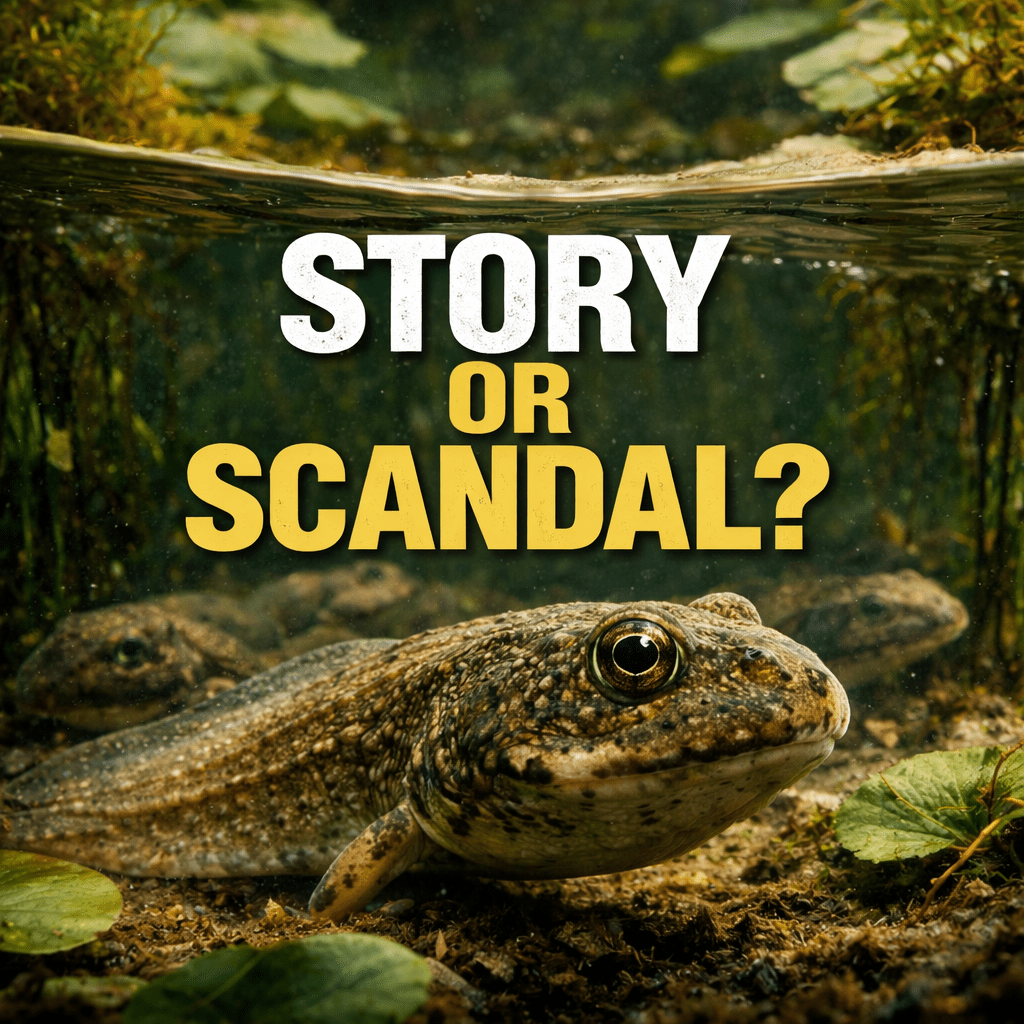
Lakehaven, WI – For two years, audiences believed they were watching the unlikely life of a single amphibian hero.
Tad, Adventures of the Pond, the acclaimed documentary that swept last season’s wildlife film circuit, was marketed as an intimate chronicle of one tadpole’s journey from gelatinous egg to mating adult frog. The film earned top honors at the WildEarth Documentary Awards and was hailed by critics as a masterclass in patience and precision.
The film identified its subject as an American bullfrog, one of North America’s largest frog species. American bullfrogs lay thousands of eggs at a time in floating gelatinous masses attached to vegetation. Within days, embryos hatch into free swimming tadpoles. Those tadpoles can remain in their aquatic form for one to two years before undergoing metamorphosis, developing hind legs first, then forelegs, while gradually absorbing their tails. Survival rates are low. Fish, birds, insects and even other frogs prey heavily on the young.
But interviews with crew members and a review of production notes suggest the film’s central premise was more stitched together than viewers realized.
According to three individuals familiar with the production, the movie did not follow one tadpole from hatching to reproduction. Instead, editors assembled footage of multiple American bullfrog tadpoles filmed over two breeding seasons in a single Midwestern pond, blending their growth stages into a seamless narrative arc.
The result was a compelling, character driven story. It may also have blurred the line between storytelling and scientific documentation.
Reached by phone, director Martin Halberg defended the production.
“We never explicitly said that it was the same individual,” Halberg said. “We thought that was obvious considering how many hundreds of tadpoles were in the pond.”
Halberg noted that American bullfrog egg masses can contain up to 20,000 eggs and that only a small fraction survive to adulthood. Tracking a single tadpole continuously through metamorphosis without disturbance, he said, would be logistically and ethically impractical.
“What we set out to do,” he said, “was tell the story of a tadpole’s life cycle. The pond provided hundreds of subjects. The life stages are universal.”
The film’s narration, however, frequently referred to “Tad” in singular, personal terms: “He survives,” “He grows stronger,” “He returns to the reeds.” Promotional materials described the documentary as following one determined tadpole against the odds.
Production logs reviewed by this newspaper indicate that at least six different tadpoles were filmed in close up sequences presented as continuous growth. Variations in tail length, spot patterns and head shape appear between consecutive shots, though the transitions are subtle.
One former crew member, who requested anonymity due to non disclosure agreements, said the approach was standard practice in some nature filmmaking.
“You cannot glue a tracker to something the size of a paper clip and expect it to behave normally,” the crew member said. “The pond had hundreds of near identical tadpoles. The editors chose the cleanest, most cinematic moments and built a life story.”
Wildlife filmmaking often condenses time and composites events for narrative clarity. Critics argue that the issue here is not editing itself but implication.
Several prominent nature publications have reacted sharply.
In a blistering editorial, Field & Fen Review called the revelation a betrayal of audience trust masquerading as artistry.
“If this was not one tadpole,” the editorial read, “then the film constructed a protagonist under the guise of documentary authenticity. That is not creative license. That is narrative fraud.”
Another outlet, The Naturalist Quarterly, urged the WildEarth Documentary Awards committee to reconsider the film’s honors.
“Documentary awards exist to celebrate observational truth,” the magazine wrote. “If the central claim of singular continuity is false, revocation should be on the table.”
The WildEarth committee said in a statement that it is reviewing the concerns but noted that many wildlife films rely on composite storytelling.
Experts say the controversy highlights a long standing tension in nature filmmaking.
“Viewers crave character driven stories,” said Dr. Elaine Porter, a media ethics scholar who studies documentary representation. “But ecosystems do not naturally produce clean three act structures. Filmmakers often assemble them.”
Porter said the ethical question hinges on expectation.
“If the average viewer reasonably believes they are watching one tracked individual, and that belief is encouraged by narration and marketing, then transparency becomes essential,” she said.
Halberg maintains that no deception occurred.
“We documented real bullfrog tadpoles in a real pond undergoing real metamorphosis,” he said. “We never added CGI. We never staged behavior. We told the life cycle truthfully.”
As for whether awards should be rescinded, Halberg was dismissive.
“If the standard is that every wildlife documentary must follow one verifiable organism from birth to death without edits, there will not be many documentaries left,” he said.
For now, Tad, Adventures of the Pond remains available on most streaming platforms, its lily pad finale intact. But in the court of public opinion, the question lingers: when does storytelling cross from illumination into illusion?
 Truth Bureau