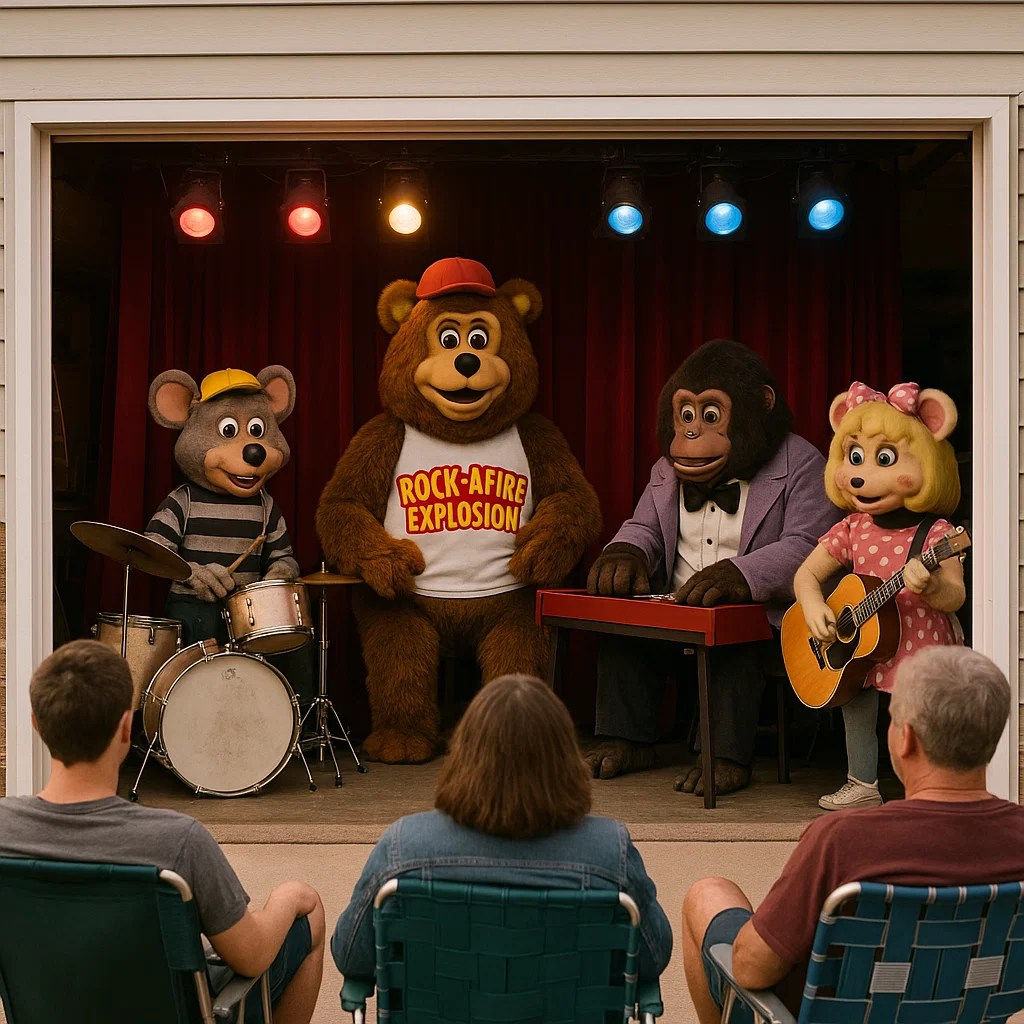
Orlando, FL – The faint whir of motors, the squeak of aging servos, and the tinny chords of a long-forgotten soundtrack filled David Mullins’ garage last Friday night. For a dozen neighbors perched on folding chairs, it was an unexpected trip back in time.
Mullins, a 42-year-old machinist with a knack for tinkering, has done what many children of the 1980s only dreamed about. He got the band back together. Piece by piece, he tracked down, repaired, and reassembled the Rock-afire Explosion, the animatronic group that once played nightly at ShowBiz Pizza Place restaurants across the country.
The Rock-afire Explosion was created by inventor Aaron Fechter in the early 1980s and became the crown jewel of ShowBiz Pizza Place. The group featured characters like Billy Bob the bear, Mitzi Mozzarella the mouse, and Fatz Geronimo the gorilla, who performed pop covers and original songs in elaborately choreographed shows. For kids celebrating birthdays under neon lights and pizza grease, it was magic.
At its peak, ShowBiz operated hundreds of locations with the Rock-afire as its signature draw. But when the chain merged with Chuck E. Cheese in the 1990s, the animatronic ensemble was phased out. Most characters were stripped for parts, thrown away, or left to decay in storage. Local historian Mark Albright, who has written about the era, put it simply: “The Rock-afire was more than machines. They were a shared experience. Kids didn’t just go for the pizza. They went for the show.”
For Mullins, who grew up celebrating birthdays at ShowBiz Pizza in Dayton, Ohio, the characters were an indelible memory. “It was like stepping into another world,” he recalled. “I always wondered what happened to them.” In 2021, that curiosity became a mission. Mullins scoured online auctions, bid against collectors, and drove across three states to salvage forgotten parts from dusty warehouses.
“One of the hardest things was finding Mitzi’s head in good condition,” he said with a laugh. “The latex rots. You end up piecing together two or three broken ones just to make something whole.”
The restoration required more than scavenging. Mullins taught himself how to rebuild servo motors, reprogram show tapes, and stitch new costumes. He even installed LED lighting in the garage ceiling to mimic the stage atmosphere. When the curtain, hand-sewn by his wife, rose on Friday night, Mullins’ friends were stunned. The characters moved, sang, and bantered just as they had three decades earlier.
“It’s surreal,” said Angela Peters, a longtime friend. “I swear I was back in 1988 with a paper plate full of pizza and soda. I didn’t expect to get teary, but I did.” Neighbors lingered long after the show ended, trading stories about childhood birthday parties and recalling favorite songs. “It brought us all back,” said another guest. “Who else has a rock band in their garage?”
Mullins insists he is not chasing fame or profit. For him, the project is about preserving a cultural artifact. “I wanted to save something that meant so much to me as a kid,” he said. “And I think it still brings joy. That is worth keeping alive.”
Some collectors view Mullins’ project as part of a larger movement. A small but devoted fan community has sprung up online, trading parts, schematics, and memories. Documentaries and fan films have celebrated the Rock-afire’s legacy, and original creator Fechter remains a cult figure.
“Every generation has its icons,” Albright said. “For some it is Disney. For others, it is the Rock-afire. What David is doing keeps that history alive, even if it is just in his garage.”
As the band’s finale wrapped up with squeaky harmonies and flickering spotlights, Mullins grinned. “Everybody always said, ‘Let’s get the band back together,’” he said, wiping sweat and grease from his hands. “Well, now we have. And they are playing again, right here at home.”
 Truth Bureau